
Hydrogen Fueling Stations
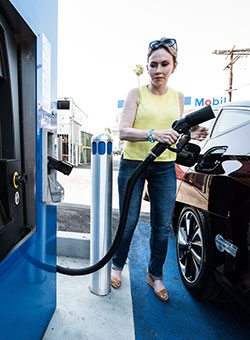
The increased number of retail hydrogen fueling locations in select markets is supporting the initial rollout of fuel cell electric vehicles (FCEVs). Manufacturers including Hyundai and Toyota are currently offering production FCEVs for sale or lease to customers in markets where hydrogen fuel is available, primarily in California. With careful planning, the focus has been to add hydrogen fuel at existing gasoline stations covering regions in northern California near San Francisco and southern California near Los Angeles and San Diego, with additional connector and destination stations.
Mobile hydrogen fuelers, where liquefied or compressed hydrogen and dispensing equipment is stored onboard a trailer, are also being developed to support the expansion of hydrogen infrastructure. These efforts are giving early FCEV adopters confidence that they can drive normally and have access to hydrogen fuel wherever they go within these regions. Efforts are also underway to expand hydrogen fueling locations in Hawaii and across the East Coast, with other markets expected to develop as consumer demand increases. In 2024, there were 54 retail stations available nationwide, mostly concentrated in California. In addition to the public, retail stations—which are available for all light-duty FCEVs, accept payment at the point of sale, and do not require special training to access—there are also private stations supporting fleets and some primarily used for demonstration and/or research. As the demand for FCEVs grows, the business case for building more stations with higher capacities improves and the volume in production of station components will bring station costs down.
The rollout of heavy-duty hydrogen trucks, such as line-haul trucks, will necessitate very large stations compared to light-duty needs. The increase in production and distribution of hydrogen for these stations could improve efficiency and utilization of expensive capital equipment, leading to lower fuel costs per kilogram, benefiting both heavy- and light-duty customers.
Hydrogen infrastructure is also developing for buses, medium-duty fleets, and material handling equipment. Unlike the public consumer stations for FCEVs that need multiple locations to cover wherever the consumer may travel, private fleet fueling stations require fewer locations or even just a central location to meet a specific fleet's needs.
Station Locations
Find hydrogen fueling stations by location or along a route. Use the advanced filters to search for private and planned stations, as well as hydrogen fueling stations to match certain search criteria.
Infrastructure Development
The availability of stations providing reasonably priced hydrogen in places where vehicles will be deployed remains a key challenge to the adoption of fuel cell vehicle technology. To address this challenge, the U.S. Department of Transportation Federal Highway Administration (FHWA) established a National Alternative Fuels Corridors grant program in 2022. In consultation with the U.S. Department of Energy, FHWA awards designation status to selected corridors to meet the national goal of achieving strategic deployment of hydrogen fueling infrastructure in the designated hydrogen corridors.
The Infrastructure Investment and Jobs Act includes $7 billion in funding for seven Regional Hydrogen Hubs (H2Hubs) to accelerate the commercial-scale deployment of low-cost, hydrogen. Additional funds from recipients will leverage nearly $50 billion to grow a hydrogen production, storage, distribution, and end-use network across the country. These H2Hubs will include projects focused on deployment of infrastructure to enable hydrogen vehicle adoption for fleets and the public.
Building hydrogen fueling infrastructure can be expensive, which is why the Inflation Reduction Act of 2022 incentivizes energy-efficient projects by providing a tax credit, 45V, of up to $3 per kilogram of hydrogen. This comprehensive set of rules for taxpayers to claim the 45V credit provides certainty to current and future hydrogen producers to stabilize and expand the market for their products. Learn more about this hydrogen production credit.
As of 2024, there are 54 open retail hydrogen stations in the United States. Additionally, there are over 20 stations in various stages of planning or construction. Most of the existing and planned stations are in California and one in Hawaii. As the market expands, hydrogen fueling stations will be matched with vehicle rollout as both grow together. Customers are expected to have similar experiences at hydrogen fueling stations as at gasoline stations, with most hydrogen dispensers being added at existing gasoline stations.
The Alternative Fueling Station Locator allows users to search for public and private hydrogen fueling stations. Suggest new hydrogen stations for inclusion in the Station Locator using the Submit New Station form.
Safety, Codes, and Standards
Many of the hydrogen safety codes and standards today are based on practices from the chemical and aerospace industries. DOE is coordinating the efforts of codes and standards organizations to develop more robust codes and standards that ensure the safe use of hydrogen for transportation and stationary applications. One of the outputs of this effort is NFPA 2, a harmonized national standard for hydrogen vehicle infrastructure.
Learn more about hydrogen safety, codes, and standards from the Hydrogen and Fuel Cell Technologies Office.
Demonstration Projects
In addition to the technical challenges being addressed through research and development, there are obstacles to successful implementation of hydrogen fueling infrastructure that can be addressed only by integrating the components into complete systems. DOE is developing and testing complete system solutions that validate integrated hydrogen and fuel cell technologies for transportation, infrastructure, and electric generation in a systems context under real-world operating conditions.
Learn more about systems analysis and technology validation from the Hydrogen and Fuel Cell Technologies Office. The National Laboratory of the Rockies also has information about hydrogen and fuel cell technology validation.
 Maps & Data
 Publications
 Tools
Tools