
Natural Gas Distribution
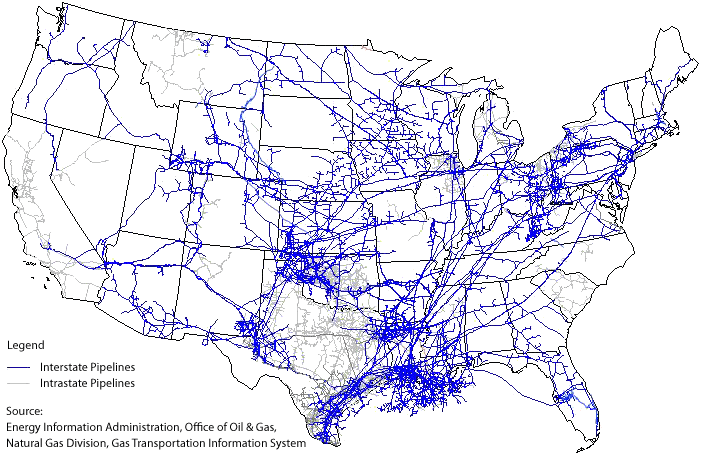
The United States has a vast natural gas pipeline system, which can quickly and economically distribute natural gas to and from almost any location in the lower 48 states. Gas is distributed using 305,000 miles of transmission pipelines (see map), while an additional 2.2 million miles of distribution pipes transport gas within utility service areas. The distribution system also includes thousands of delivery, receipt, and interconnection points; hundreds of storage facilities; and approximately 50 points for exporting and importing natural gas.
U.S. Natural Gas Pipeline Network
In addition to distribution via the nation's extensive pipeline network, renewable natural gas (RNG) can be dispensed at production sites, such as landfills or wastewater treatment plants with the ability to clean and upgrade biogas (the gaseous product of the decomposition of organic matter). Like conventional natural gas, RNG can be compressed or liquefied for use in vehicles.
Compressed Natural Gas Distribution
The vast majority of the nation's natural gas supply is distributed via the established natural gas distribution system. Most natural gas fueling stations dispense compressed natural gas (CNG), which is usually compressed on site. CNG is used in light-, medium-, and heavy-duty vehicles.
To find this fuel, see CNG Fueling Station Locations.
Liquefied Natural Gas Distribution
Liquefied natural gas, or LNG, must be super-cooled and stored in its liquid form at -260°F before being converted back into a gas. LNG must be in its gaseous form before it enters the domestic pipeline distribution system and is ultimately delivered to the end user. LNG can be used in vehicles, although CNG vehicles are more common.
While most natural gas fueling stations in the United States dispense CNG, a limited number of LNG fueling stations are available. Many LNG users are fleets that have private fueling infrastructure for their vehicles; however, numerous public LNG fueling sites are available to fleets. Large-scale liquefaction facilities provide LNG fuel for transportation nationwide, and LNG must be delivered to stations via trucks.
To find this fuel, see LNG Fueling Station Locations.
 Maps & Data
 Case Studies
 Publications
 Tools
Tools