
Plug-In Hybrid Electric Vehicles
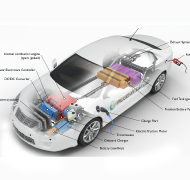
Plug-in hybrid electric vehicles (PHEVs) use batteries to power an electric motor, as well as another fuel, such as gasoline or diesel, to power an internal combustion engine or other propulsion source. PHEVs can charge their batteries through charging equipment and regenerative braking. Using electricity from the grid to run the vehicle some or all of the time reduces operating costs and fuel use, relative to conventional vehicles. PHEVs may also produce lower levels of pollution, depending on the electricity source and how often the vehicle is operated in all-electric mode.
There are several light-duty PHEVs commercially available, and medium-duty vehicles are now entering the market. Medium- and heavy-duty vehicles can also be converted to PHEVs. Although PHEVs are generally more expensive than similar conventional and hybrid vehicles, some cost can be recovered through fuel savings or state incentives.
Powered by Electric Motor and Combustion Engine
PHEVs have an internal combustion engine and an electric motor, which uses energy stored in batteries. PHEVs generally have larger battery packs than hybrid electric vehicles. This makes it possible to drive moderate distances using just electricity (about 15 to 60-plus miles in current models), commonly referred to as the "electric range" of the vehicle.
During urban driving, most of a PHEV's power can come from stored electricity. For example, a light-duty PHEV driver might drive to and from work on all-electric power, plug the vehicle in to charge at night, and be ready for another all-electric commute the next day. The internal combustion engine powers the vehicle when the battery is mostly depleted, during rapid acceleration, or when intensive heating or air conditioning loads are present. Some heavy-duty PHEVs work the opposite way, with the internal combustion engine used for driving to and from a job site and electricity used to power the vehicle's auxiliary equipment or control the cab's climate while at the job site.
Fueling and Driving Options
PHEV batteries can be charged by an outside electric power source, by the internal combustion engine, or through regenerative braking. During braking, the electric motor acts as a generator, using the energy to charge the battery, thereby recapturing energy that would have been lost. Learn more about charging PHEVs.
PHEV fuel consumption depends on the distance driven between battery charges. For example, if the vehicle is never plugged in to charge, fuel economy will be about the same as a similarly sized hybrid electric vehicle. If the vehicle is driven a shorter distance than its all-electric range and plugged in to charge between trips, it may be possible to use only electric power. Therefore, consistently charging the vehicle is the best way to maximize the electric benefits.
Fuel-Efficient System Design
Beyond battery storage and motor power, there are various ways to combine the power from the electric motor and the engine. The two main configurations are parallel and series. Some PHEVs use transmissions that allow them to operate in either parallel or series configurations, switching between the two based on the drive profile.
-
Parallel hybrid operation connects the engine and the electric motor to the wheels through mechanical coupling. Both the electric motor and the engine can drive the wheels directly.
-
Series plug-in hybrids use only the electric motor to drive the wheels. The internal combustion engine is used to generate electricity for the motor. Vehicles of this type are often referred to as extended-range electric vehicles. The electric motor drives the wheels almost all of the time, but the vehicle can switch to work like a parallel hybrid at highway speeds when the battery is depleted.