Skip Navigation to main content U.S. Department of Energy Energy Efficiency and Renewable Energy
Alternative Fuels and Advanced Vehicles Data Center
About the AFDCFuelsVehiclesFleetsIncentives and LawsData, Analysis and TrendsInformation ResourcesHome
Alternative and Advanced Vehicles

Hydrogen Emissions

Hydrogen fuel cell vehicles emit only water vapor and some hydrogen—neither of which are concerns for local air pollution.

Upstream Emissions

Similar to electricity, hydrogen is an energy carrier that can be produced from various feedstocks. These feedstocks and production methods need to be considered when looking at hydrogen emissions on a large scale.

Argonne National Laboratory's (ANL) report Fuel Choices for Fuel Cell Vehicles: Well-to-Wheels Energy and Emission Impacts (PDF 82 KB) features analysis of greenhouse gas (GHG) emissions for 10 hydrogen production and distribution pathways. Download Adobe Reader. ANL chose the hydrogen pathways to represent a range of the most popular production methods as well as some that are likely to be pursued. These pathways are detailed in the table below.

Hydrogen Production and Distribution Pathways
Pathway NumberDescription
1Central GH2, NG: Gaseous hydrogen produced from natural gas via steam methane reforming in a centralized plant. This is currently the most popular pathway.
2Central LH2, NG: Liquid hydrogen produced via pathway #1. Liquid hydrogen enables longer driving range but requires strict heat insulation and can suffer from boil-off loss.
3Station GH2, NG: Gaseous hydrogen produced from natural gas via steam methane reforming at a refueling station. Producing hydrogen at the station instead of a central plant limits hydrogen transportation costs.
4Station LH2, NG: Liquid hydrogen produced via pathway #3.
5Solar PV GH2: Gaseous hydrogen produced by electrolyzing water with electricity produced by photovoltaic solar panels in a central location.
6Solar PV LH2: Liquid hydrogen produced via pathway #5.
7Electrolysis GH2, U.S. Mix: Gaseous hydrogen produced by electrolyzing water with average U.S. grid electricity at refueling stations; 54% of the U.S. grid electricity comes from coal, 18% from nuclear, 15% from natural gas, 1% from oil, and 12% from other energy sources.
8Electrolysis LH2, U.S. Mix: Liquid hydrogen produced via pathway #7.
9Electrolysis GH2, Renewables: Gaseous hydrogen produced at refueling stations by electrolyzing water with electricity produced by renewable sources.
10Electrolysis LH2, Renewables: Liquid hydrogen produced via pathway #9.
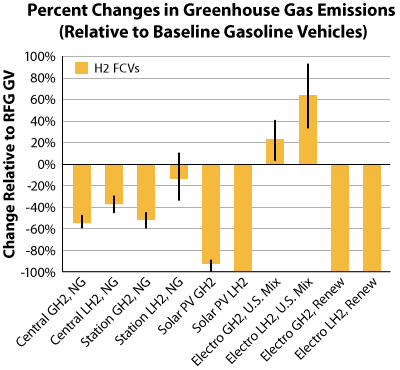
Chart showing the percent changes in greenhouse gas emissions (relative to baseline gasoline vehicles) for hydrogen fuel cell vehicles.  Hydrogen use reduces GHG emissions for all fuel pathways except when the fuel is produced by electrolysis from typical grid electricity.

Source: Fuel Choices for Fuel Cell Vehicles: Well-to-Wheels Energy and Emission Impacts (PDF 82 KB), ANL. Download Adobe Reader.

The graph shows that hydrogen production for all fuel pathways creates fewer GHG emissions except when the fuel is produced by electrolysis from typical grid electricity. It's important to note that gaseous hydrogen produces fewer GHGs than liquid hydrogen in all cases except when the liquefaction is done by renewable sources of energy.

In its 2007 study, Fuel Cycle Assessment: Well-to-Wheels Energy Inputs, Emissions, and Water Impacts (PDF 1.5 MB) the California Energy Commission (CEC) examined GHG emissions from various hydrogen pathways. Download Adobe Reader. The only major difference between the two studies was that the CEC found gaseous hydrogen produced from grid electrolysis creates 33% fewer GHG emissions instead of increasing emissions by 20%. This could be because California produces less-polluting electricity or CEC assumed advancements made in electrolysis efficiency.

The ANL study also investigated hydrogen's effects on petroleum use, a primary indicator of energy security. It found that using hydrogen as a fuel reduced petroleum use by nearly 100% regardless of fuel pathway (see figure below). The CEC study agreed with this conclusion.

Chart showing percent changes in well-to-wheels petroleum use (relative to baseline gasoline vehicles).  The chart is based on an Argonne National Laboratory study that investigated hydrogen's effects on petroleum use, a primary indicator of energy security. It found that using hydrogen as a fuel reduced petroleum use by nearly 100% regardless of fuel pathway.

Source: Fuel Choices for Fuel Cell Vehicles: Well-to-Wheels Energy and Emission Impacts (PDF 82 KB), ANL. Download Adobe Reader.