
Hybrid Electric Vehicles
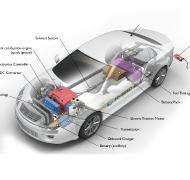
Today's hybrid electric vehicles (HEVs) are powered by an internal combustion engine in combination with one or more electric motors that use energy stored in batteries. HEVs combine the benefits of high fuel economy and low tailpipe pollution with the power and range of conventional vehicles.
A wide variety of HEV models are currently available. Although HEVs are often more expensive than similar conventional vehicles, some cost may be recovered through fuel savings or state incentives. Compare HEV and non-hybrid models side by side using the "Can a Hybrid Save Me Money?" tool on FuelEconomy.gov. The tool compares the costs of a selected HEV with a comparably equipped non-hybrid model from the same manufacturer and provides fuel cost savings associated with the HEV option.
Help from an Electric Motor
In an HEV, the extra power provided by the electric motor may allow for a smaller combustion engine. The battery can also power auxiliary loads and reduce engine idling when the vehicle is stopped. Together, these features result in better fuel economy without sacrificing performance.
Regenerative Braking
An HEV cannot plug in to off-board sources of electricity to charge the battery. Instead, the vehicle uses regenerative braking and the internal combustion engine to charge. The vehicle captures energy normally lost during braking by using the electric motor as a generator and storing the captured energy in the battery.
View an animation showing how HEVs work. Download Flash Player or view the text version.
Fuel-Efficient System Design
HEVs can be either mild or full hybrids, and full hybrids can be designed in series or parallel configurations.
Mild hybrids—also called micro hybrids—use a battery and electric motor to help power the vehicle and can allow the engine to shut off when the vehicle stops (such as at traffic lights or in stop-and-go traffic), further improving fuel economy. Mild hybrid systems cannot power the vehicle using electricity alone. These vehicles generally cost less than full hybrids but provide less fuel economy benefit than full hybrids.
Full hybrids have larger batteries and more powerful electric motors, which can power the vehicle for short distances and at low speeds. These vehicles cost more than mild hybrids but provide better fuel economy benefits.
There are different ways to combine the power from the electric motor and the engine. Parallel hybrids—the most common HEV design—connect the engine and the electric motor to the wheels through mechanical coupling. Both the electric motor and the internal combustion engine drive the wheels directly. Series hybrids, which use only the electric motor to drive the wheels, are more commonly found in plug-in hybrid electric vehicles.