
Renewable Natural Gas Production
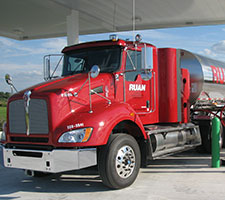
This milk transport truck fuels up at a renewable natural gas station. Photo from ampCNG
Renewable natural gas (RNG) is a pipeline-quality gas that is fully interchangeable with conventional natural gas and thus can be used in natural gas vehicles. RNG is essentially biogas (the gaseous product of the decomposition of organic matter) that has been processed to purity standards. Like conventional natural gas, RNG can be used as a transportation fuel in the form of compressed natural gas (CNG) or liquefied natural gas (LNG). RNG qualifies as an advanced biofuel under the Renewable Fuel Standard.
Biomethane, which is another term for this purified pipeline-quality fuel, refers to biogas that has also been cleaned and conditioned to remove or reduce non-methane elements. Biogas is produced from various biomass sources through a biochemical process, such as anaerobic digestion, or through thermochemical means, such as gasification. With minor cleanup, biogas can be used to generate electricity and heat and is used as a replacement for traditional natural gas to generate combined electricity and heating for power plants—not in vehicle applications.
To fuel vehicles, biogas must be processed to a higher purity standard. This process is called conditioning or upgrading, and involves the removal of water, carbon dioxide, hydrogen sulfide, and other trace elements. The resulting RNG, or biomethane, has a higher content of methane than raw biogas, which makes it comparable to conventional natural gas and thus a suitable energy source in applications that require pipeline-quality gas, such as vehicle applications.
For a comprehensive list of projects that are upgrading gas for pipeline injection or use as vehicle fuel, see the Renewable Natural Gas Database developed and maintained by Argonne National Laboratory.
Biogas from Landfills
Landfills are designated locations for disposal of waste collected from residential, industrial, and commercial entities. Landfills are the third-largest source of human-related methane emissions in the United States, according to the U.S. Environmental Protection Agency (EPA). Biogas from landfills is also called landfill gas (LFG), as the digestion process takes place in the ground rather than in an anaerobic digester. As of July 2023, there were 532 operational LFG projects in the United States, according to the EPA. However, most of these projects use biogas to produce electricity rather than power natural gas vehicles.
Learn about these LFG alternative fuel transportation projects:
- Waste Management's Altamont Landfill near Livermore, California
- St. Landry Parish Landfill in Washington, Louisiana
- Joint Water Pollution Control Plants in Los Angeles County, California
Biogas from Livestock Operations
Biogas recovery systems at livestock operations can be used to produce RNG. Animal manure is collected and delivered to an anaerobic digester to stabilize and optimize methane production. The resulting biogas can be processed into RNG and used to fuel natural gas vehicles or produce electricity.
As of 2023, there were about 470 anaerobic digester systems operating at commercial livestock farms in the United States. Most of these facilities use biogas for electricity generation. A few farms are using biogas to produce transportation fuel, including Calgren Dairy Fuels in California and Fair Oaks Farms in Indiana. EPA's AgSTAR database provides more information about the use of such systems in the United States.
Biogas from Wastewater Treatment
Biogas can be produced by digesting the solids removed in the wastewater treatment process. According to EPA estimates, this biogas potential is about 1 cubic foot of digester gas per 100 gallons of wastewater. Energy generated at U.S. wastewater treatment plants (WWTPs) could potentially meet 12% of the national electricity demand, according to a study released by the National Association of Clean Water Agencies, the Water Environment Research Foundation, and the Water Environment Federation. This could spur some production of RNG for vehicle use as well.
There are more than 16,000 WWTPs in the United States, but only about 1,200 have anaerobic digesters and of those, 860 have the equipment to use their biogas on site. The City of Longmont Wastewater Treatment Plant in Colorado is an example of a plant that uses biogas to produce RNG for use in vehicles.
Other Sources of Biogas
Other sources of biogas include organic waste from industrial, institutional, and commercial entities, such as food manufacturing and wholesalers, supermarkets, restaurants, hospitals, and educational facilities. Learn about the City of Perris, California, biodigester, that produces enough RNG to fuel their fleet of 900 vehicles.
Biogas can also be produced from lignocellulosic material (such as crop residues, woody biomass, and dedicated energy crops) via thermochemical conversions, co-digestion, and dry fermentation. These technologies are underway in Europe, with limited applications in the United States.
Related Content
 Case Studies
 Publications
- Harnessing Renewable Natural Gas to Power Today's Trucks
- Low-Carbon Natural Gas for Transportation: Well-to-Wheels Emissions and Potential Market Assessment in California
- Renewable Natural Gas (RNG), The Solution to a Major Transportation Challenge - A Clean, Secure, Commercially Viable Replacement for Diesel Fuel Today
 Tools
Tools