
Propane Fueling Stations
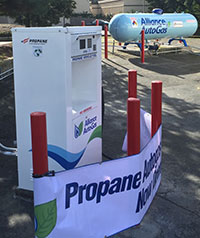
Thousands of liquefied petroleum gas (propane) fueling stations are available in the United States.
Station Locations
Find propane fueling stations by location or along a route. Use the Advanced Filters to search for private and planned stations, as well as propane fueling stations to match certain search criteria.
Infrastructure Development
Infrastructure availability is the foundation for the acceptance of any fuel. Fleet managers depend on being able to locate fuel at a station that meets the needs of their fleet within a reasonable distance at a competitive price; propane infrastructure for vehicles is well established across the United States.
The Alternative Fueling Station Locator allows users to search for public and private propane fueling stations and prioritize those stations that have vehicle-specific fueling capabilities. Users can suggest new propane stations for inclusion in the Station Locator using the Submit New Station form.
Types of Infrastructure
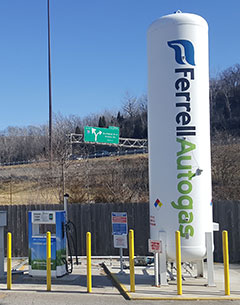
Propane dispensers can be placed alongside gasoline, diesel, or other alternative fuel dispensers. The infrastructure needed for propane is very similar to that for gasoline and diesel, although propane is delivered to the vehicle under pressure so that it will remain a liquid. Propane is transported to a site via a delivery truck and put into on-site storage tanks, traditionally aboveground.
Existing propane equipment can be modified for vehicle fueling, or fuel providers and fleet managers can install fueling dispensers and pump systems built for propane vehicle fueling. There are a variety of vehicle-specific propane fueling dispensers, which are similar to gasoline dispensers. The pump system is the most important consideration for propane vehicle fueling infrastructure, as a system designed for bottle gas may not be appropriate for vehicle fueling. Learn more about guidelines for installing propane fueling equipment and dispensing propane on the Propane Education & Research Council website.
Dispenser Nozzles and Connectors
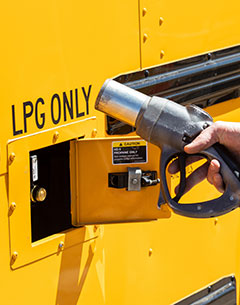
A typical propane fueling station will have a dispenser equipped with a hose and nozzle or connector. Fueling a propane vehicle requires attaching the nozzle to a connector on the vehicle. The National Fire Protection Association (NFPA) Code 58 (beginning with the 2017 version) requires all new vehicles to be equipped with the quick-release “Type K15” connector as of January 1, 2020. The associated Type K15 nozzle allows for one-handed fueling, does not require the use of personal protective equipment, such as gloves and face shield (which are required for the older ACME connector), and limits fugitive air pollution during disconnection. The ACME QCC screw-on connector has been used since 1994 for both vehicles and bottle filling. For vehicles with the ACME connector, there is an adapter for the Type K15 nozzle. However, people considering vehicle purchases should order the correct connector to be compatible with their planned fueling dispenser.
Codes and Safety
As with any fuel, it is important to know and consider the safety guidelines when establishing infrastructure. This includes the CSA Natural Gas and Propane Installation Code B149.5-15, which contains requirements for the placement of propane fuel systems and containers in vehicles, and NFPA 58 Vehicular Liquefied Petroleum Gas Code, which applies to the design and installation requirements of propane fueling facilities. Your local fire marshal can advise whether local permits are needed for installations. In addition, your local propane supplier can help determine the right amount of storage needed to adequately meet vehicle fueling needs.
Cost of Fueling Infrastructure
Fortunately, propane production, storage, and bulk distribution capabilities already exist across most of the United States. This means establishing propane fueling infrastructure for vehicle fueling requires only the build-out of dispensing equipment—including the storage tank, pump, dispenser and "cabinet," hose, nozzle, and metering system—and possibly a card reader at a station. Learn more about costs associated with propane vehicle fueling infrastructure.

Building a New Station: Many suppliers offer an inexpensive lease of the tank, pump, and dispensing equipment in return for a fuel supply contract. In these cases, the station owner or fleet is responsible only for the cost of equipment that cannot be removed from the site when the fuel contract expires, such as the electricity line or the concrete pad for the storage tank. This can make the upfront cost of propane infrastructure very affordable. The cost of establishing private infrastructure, as opposed to a lease, includes purchasing and installing the necessary equipment for storing and dispensing propane. This cost can be as low as $65,000, varying based on the current infrastructure (e.g., electric connections and concrete pad) and need.
Upgrading Existing Retail Sites: Most propane vehicles can fuel at existing retail sites that sell propane in small volumes, such as for filling grill canisters and mowers. Propane vehicle fueling is considered a "secondary" service at stations with dispensers intended for small propane filling applications. While these stations can fuel propane vehicles, they have limited vehicle-specific fueling capabilities. Upgrading dispensing equipment at those sites to a retail-style metering dispenser that is dedicated (or purpose-built) for vehicle fueling and has a card reader may accommodate broader vehicle fueling and drive demand. The pump may also need an upgrade to provide a faster fill rate—ideally 8 to 12 gallons per minute or more—and adequate fill pressure for vehicles. Stations with these upgrades may consider propane vehicle fueling a "primary" service.
Station owners and fleet managers committed to a seamless fueling experience for their drivers may also wish to consider other equipment, such as a fueling canopy or a hose retractor. With these improvements, propane drivers will have an experience similar to fueling a gasoline vehicle at a conventional station. Station owners may choose to acquire additional equipment based on demand in their area and fleet interest in propane. Upgrade construction can take as little as four to six weeks.
Resources
Visit the Propane Education & Research Council website for information about propane autogas technician training or to learn more about fleet garage requirements. For additional information on propane vehicle and infrastructure training, visit the National Alternative Fuels Training Consortium website.
 Maps & Data
 Case Studies
 Publications
 Tools
Tools