
Propane Production and Distribution
Propane is a byproduct of natural gas processing and crude oil refining, with almost equal amounts of production derived from each of these sources. Most of the propane consumed in the United States is produced in North America. In addition to conventional propane, fuel suppliers are producing renewable propane—which is made from renewable feedstocks.
Production
Propane is produced from liquid components recovered during natural gas processing. These components include ethane, methane, propane, and butane, as well as heavier hydrocarbons. Propane and butane, along with other gases, are also produced during crude oil refining.
Chemically identical to conventional propane, renewable propane is produced from non-petroleum feedstocks such as natural fats, vegetable oils, and various types of grease. Although the number of producers is small, renewable propane is currently produced in biodiesel refineries.
Distribution
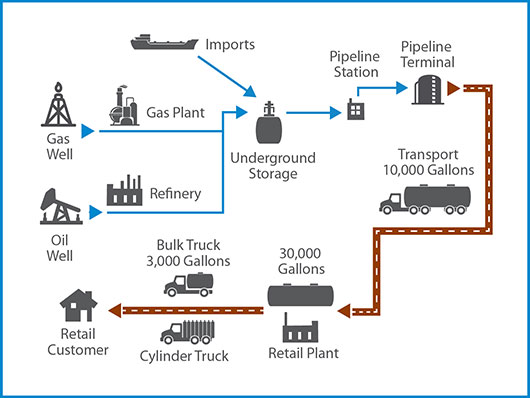
Propane is shipped from its point of production to bulk distribution terminals via pipeline, railroad, barge, truck, or tanker ship. Propane marketers fill trucks at the terminals and distribute propane to end users, including retail fuel sites.
Find propane fueling station locations.
Schematic of a typical propane distribution route
 Maps & Data
 Publications
 Tools
Tools