
New Jersey Laws and Incentives
Listed below are the summaries of all current New Jersey laws, incentives, regulations, funding opportunities, and other initiatives related to alternative fuels and vehicles, advanced technologies, or air quality. You can go directly to summaries of:
State Incentives
New Jersey's National Electric Vehicle Infrastructure (NEVI) Planning
The U.S. Department of Transportation’s (DOT) NEVI Formula Program required the New Jersey Department of Transportation (NJDOT) to submit an annually updated EV Infrastructure Deployment Plan (Plan) for fiscal years 2022 through 2026 to their FHWA Division Office, describing how the state intended to distribute NEVI funds and their physical and cybersecurity strategies, and including a Community Engagement Outcomes Report. The submitted plans must address updated NEVI Guidance.
For more information about New Jersey’s NEVI planning process, see the New Jersey Department of Environmental Protection Infrastructure Investment and Jobs Act website.
Zero Emissions Vehicle (ZEV) Tax
ZEVs that are sold on or after October 1, 2024, and before July 1, 2025, are subject to a 3.3125% tax. ZEVs that are sold on or after July 1, 2025, will be subject to a 6.625% tax. For a list of qualified ZEVs, see the New Jersey Department of the Treasury ZEV Sales Tax Exemption website.
(Reference New Jersey Statutes 54:32B-3 and 54:32B-8.55)
Electric Vehicle (EV) and EV Charger Rebate
The New Jersey Board of Public Utilities’ (NJBPU) Charge Up New Jersey program offers point-of-sale rebates to New Jersey residents for the purchase or lease of a new light-duty EV. A rebate of $1,500 is available for eligible EVs with a manufacturer suggested retail price of up to $55,000. Applicants that meet certain income thresholds are eligible for an additional $2,500 rebate through NJBPU’s Charge Up+ incentive, for a total rebate of $4,000. Plug-in hybrid electric vehicles are not eligible for this rebate.
The NJBPU also offers residents a $250 rebate for the purchase of an eligible Level 2 EV charger through the Charge Up Residential Charger Program. For more information, including eligibility requirements, income qualifications, and funding availability, see the NJBPU EV Incentive Programs and Charge Up New Jersey websites.
(Reference New Jersey Statutes 48:25-1 through 48:25-8)
Multifamily Housing (MFH) Electric Vehicle (EV) Charger Grants
The New Jersey Board of Public Utilities’ (NJBPU) MFH EV Charger Incentive Program offers grants to MFH owners of up to $4,000 for the purchase and installation of eligible, dual-port Level 2 EV chargers. MFH developments in overburdened municipalities or deed-restricted low/moderate income developments are eligible for grants of up to $6,000. For more information, including how to apply, see the NJBPU EV Incentive Programs website.
Medium- and Heavy-Duty (MHD) Electric Vehicle (EV) Charger Grants
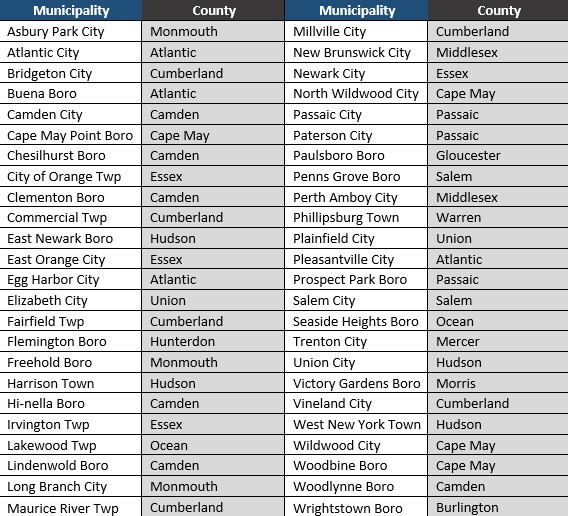
The New Jersey Board of Public Utilities’ (NJBPU) MHD EV Charging Program offers grants for businesses for the purchase and installation of eligible publicly accessible direct current (DC) fast chargers, including make ready expenses for electrical service. Grants of of up to $225,000 per DC fast charger, with requests allowed for up to 6 DC fast chargers per application. Applicants must be located or operated within overburdened communities to qualify. This program is funded by Regional Greenhouse Gas Initiative (RGGI) proceeds. For more information, including funding availability and eligibility requirements, see the NJBPU EV Incentive Program website.
Electric Vehicle (EV) Toll Discount Program
New Jersey Turnpike Authority’s Green Pass Discount Plan provides a 10% discount on off-peak New Jersey Turnpike and Garden State Parkway toll rates for drivers of EVs that have a fuel economy of 45 miles per gallon or higher and meet the California Super Ultra Low Emission Vehicle standard. Vehicles must register with New Jersey E-ZPass. For more information, including application instructions, see the E-ZPass Discount Programs website.
Clean Truck Replacement Program
The Port Authority of New York & New Jersey’s (PANYNJ) Truck Replacement Program (Program) provides funding for the replacement of eligible Class 8 trucks with model year (MY) 2015 or newer diesel vehicles. Eligible replacement trucks must meet U.S. Environmental Protection Agency heavy-duty vehicle standards. Funding is available for up to 50% of the replacement truck purchase price, up to $25,000, whichever is less. Vehicles eligible for retirement include Class 8 port drayage trucks with MY 1999 through 2009 engines. Funding is limited to two replacement trucks per applicant. Additional rules and conditions apply. For more information, see the PANYNJ Program website.
Reduced Propane Fuel Tax
The tax imposed on liquefied petroleum gas (LPG), including propane, used to operate a motor vehicle is equal to half the tax paid on the sale or use of gasoline, or $0.0525 per gallon.
(Reference New Jersey Statute 54:39-103)
Electric Vehicle (EV) Charger Grants
The New Jersey Department of Environmental Protection (NJDEP) provides grants through the It Pay$ to Plug In: New Jersey’s Electric Vehicle Workplace Charging Grant Program (Program) for EV charger installation. Grants are available in the following amounts:
| EV Charging Station Type | Maximum Rebate Amount per Port | Number of Eligible EV Charging Ports per Location |
|---|---|---|
| Level 1 | $750 | Minimum of 5 |
| Level 2 | $4,000 | Minimum of 2 and maximum of 20 |
Grants are awarded on a first-come, first-served basis. Eligible EV chargers must be located at workplaces, government agencies, non-profits, or multifamily housing. The Program is part of New Jersey’s Energy Master Plan. For more information, including application and eligibility requirements, see the NJDEP It Pay$ to Plug In website.
Natural Gas Vehicle (NGV) Weight Exemption
An NGV may exceed the state’s gross vehicle weight limits by a weight equal to the difference between the weight of the vehicle with the natural gas tank and fueling system and the weight of a comparable vehicle with a diesel tank and fueling system. The NGV maximum gross weight may not exceed 82,000 pounds.
(Reference New Jersey Statutes 39:3-84.1)
Electric Vehicle (EV) Fleet Grant Program
The New Jersey Board of Public Utilities (NJBPU) offers local and state government fleets grants for the purchase of new or pre-owned all-electric vehicles and associated charging infrastructure. Grants are awarded on a first-come, first-served basis. Grant award amounts vary based on vehicle or charger type and number of awards vary based on government entity type and population size. Award amounts range from $4,000 for light-duty EVs or Level 2 chargers to $180,000 per DC fast charger. Overburdened municipalities are eligible for additional incentives. For more information, including eligibility requirements and how to apply, see the NJBPU Clean Fleet EV Incentive Programs website.
Medium- and Heavy-Duty (MHD) Zero Emission Vehicle (ZEV) Voucher Program
The New Jersey Zero Emission Incentive Program (NJ ZIP) will pilot a voucher program for the purchase of new MHD ZEVs registered in New Jersey. Eligible applicants include commercial, industrial, or institutional organizations. Phase 3 funding in 2025 offers vouchers based on gross vehicle weight rating (GVWR):
| GVWR | Vehicle Class | Amount |
|---|---|---|
| 8,501 - 10,000 pounds (lbs.) | Class 2b | $15,000 |
| 10,0001 - 14,000 lbs. | Class 3 | $50,000 |
| 14,001 - 16,000 lbs. | Class 4 | $65,000 |
| 16,001 - 19,500 lbs. | Class 5 | $75,000 |
| 19,501 - 26,000 lbs. | Class 6 | $90,000 |
| 26,001 - 33,000 lbs. | Class 7 | $135,000 |
| 33,001+ lbs. | Class 8 | $175,000 |
Some business and vehicle types are eligible for stackable bonus amounts. Applicants may receive a maximum of $3,000,000 in vouchers per funding phase. Vehicles must be purchased through qualified vendors. Funding is set aside, with conditions, for applicants with vehicles domiciled in overburdened communities. This program is funded by Regional Greenhouse Gas Initiative proceeds. For more information, including eligibility requirements, see the NJ ZIP Program website.
(Reference New Jersey Administrative Code 7:27D)
Public Electric Vehicle (EV) Charger Grants
The New Jersey Board of Public Utilities’ (NJBPU) EV Tourism Program offers grants to local businesses and municipalities for the purchase of up to six Level 2 and two direct current (DC) fast chargers for installation at New Jersey tourism sites and landmarks. Level 2 EV charging stations are eligible for grants of up to $5,000, and DC fast chargers are eligible for grants of up to $100,000. Overburdened municipalities can qualify for 50% bonus incentives. Eligible sites include locations along eligible corridors and at hotels. Additional restrictions apply. For more information, including eligibility criteria and funding availability, see the NJBPU EV Incentive Program website.
Electric Vehicle (EV) and EV Charger Grant Program
The New Jersey Department of Environmental Protection (NJDEP) administers the eMobility Grant Program, which provides funding to increase electric mobility solutions including carshare, rideshare, ride-hailing, fixed-route transit, microtransit, and e-mobility services for residents in underserved areas. Eligible projects include EVs and EV chargers. Priority will be given to projects in overburdened communities. For more information, including funding availability and eligibility requirements, see the NJDEP Drive Green e-Mobility website.
Electric School Bus Grant
The New Jersey Department of Environmental Protection (NJDEP) offers grants to school districts and school bus contractors for the purchase of electric school buses and charging infrastructure. Grants awards vary based on charger type and whether the applicant operates in an overburdened community. Grants are available in the following amounts:
| Technology | Maximum Grant Amount | Overburdened School District Maximum Grant Amount |
|---|---|---|
| Electric School Bus + Level 2 Charger | $270,000 | $300,000 |
| Electric School Bus + Direct Current Fast Charger | $290,000 | $320,000 |
| Electric School Bus + Bi-Directional Charging Option | $320,000 | $350,000 |
School bus contractors must apply in conjunction with a specified school or school district. For more information, including eligibility requirements, program evaluation criteria, bi-directional charging details, and current or past solicitations, see the NJDEP Electric School Bus Grant Program website.
Utility / Private Incentives
Atlantic City Electric (ACE) - New Jersey
Atlantic City Electric (ACE) is an investor-owned utility (IOU) that operates in New Jersey. This page provides a summary of the types of incentives provided by the utility related to alternative fuels and vehicles. For more information on these incentives, see the Atlantic City Electric (ACE) website.
Residential Incentives
No incentives currently offered
- Make-Ready or Pre-Wiring Rebate for EV Chargers
No incentives currently offered
Non-Residential Incentives
No incentives currently offered
- Make-Ready or Pre-Wiring Rebate for EV Chargers
No incentives currently offered
Borough of Butler - New Jersey
Borough of Butler is a municipal utility that operates in New Jersey. This page provides a summary of the types of incentives provided by the utility related to alternative fuels and vehicles. For more information on these incentives, see the Borough of Butler website.
Residential Incentives
No incentives currently offered
No incentives currently offered
No incentives currently offered
Non-Residential Incentives
No incentives currently offered
No incentives currently offered
No incentives currently offered
Borough of Lavallette - New Jersey
Borough of Lavallette is a municipal utility that operates in New Jersey. This page provides a summary of the types of incentives provided by the utility related to alternative fuels and vehicles. For more information on these incentives, see the Borough of Lavallette website.
Residential Incentives
No incentives currently offered
No incentives currently offered
No incentives currently offered
Non-Residential Incentives
No incentives currently offered
No incentives currently offered
No incentives currently offered
Borough of Madison - New Jersey
Borough of Madison is a municipal utility that operates in New Jersey. This page provides a summary of the types of incentives provided by the utility related to alternative fuels and vehicles. For more information on these incentives, see the Borough of Madison website.
Residential Incentives
No incentives currently offered
No incentives currently offered
No incentives currently offered
Non-Residential Incentives
No incentives currently offered
No incentives currently offered
No incentives currently offered
Borough of Milltown - New Jersey
Borough of Milltown is a municipal utility that operates in New Jersey. This page provides a summary of the types of incentives provided by the utility related to alternative fuels and vehicles. For more information on these incentives, see the Borough of Milltown website.
Residential Incentives
No incentives currently offered
No incentives currently offered
No incentives currently offered
Non-Residential Incentives
No incentives currently offered
No incentives currently offered
No incentives currently offered
Borough of Park Ridge - New Jersey
Borough of Park Ridge is a municipal utility that operates in New Jersey. This page provides a summary of the types of incentives provided by the utility related to alternative fuels and vehicles. For more information on these incentives, see the Borough of Park Ridge website.
Residential Incentives
No incentives currently offered
No incentives currently offered
No incentives currently offered
Non-Residential Incentives
No incentives currently offered
No incentives currently offered
No incentives currently offered
Borough of Seaside Heights - New Jersey
Borough of Seaside Heights is a municipal utility that operates in New Jersey. This page provides a summary of the types of incentives provided by the utility related to alternative fuels and vehicles. For more information on these incentives, see the Borough of Seaside Heights website.
Residential Incentives
No incentives currently offered
No incentives currently offered
No incentives currently offered
Non-Residential Incentives
No incentives currently offered
No incentives currently offered
No incentives currently offered
Borough of South River - New Jersey
Borough of South River is a municipal utility that operates in New Jersey. This page provides a summary of the types of incentives provided by the utility related to alternative fuels and vehicles. For more information on these incentives, see the Borough of South River website.
Residential Incentives
No incentives currently offered
No incentives currently offered
No incentives currently offered
Non-Residential Incentives
No incentives currently offered
No incentives currently offered
No incentives currently offered
Fishers Island Electric Corporation - New Jersey
Fishers Island Electric Corporation is an investor-owned utility (IOU) that operates in multiple states. This page provides a summary of the types of incentives provided by the utility related to alternative fuels and vehicles. For more information on these incentives, see the Fishers Island Electric Corporation website.
Residential Incentives
No incentives currently offered
No incentives currently offered
No incentives currently offered
Non-Residential Incentives
No incentives currently offered
No incentives currently offered
No incentives currently offered
Jersey Central Power & Light (JCP&L) - New Jersey
Jersey Central Power & Light (JCP&L) is an investor-owned utility (IOU) that operates in New Jersey. This page provides a summary of the types of incentives provided by the utility related to alternative fuels and vehicles. For more information on these incentives, see the Jersey Central Power & Light (JCP&L) website.
Residential Incentives
- EV Time-of-Use (TOU) Rate
- EV Direct Current (DC) Fast Charging Station Purchase Rebate
- EV Level 2 Charging Station Installation Rebate
- Make-Ready or Pre-Wiring Rebate for EV Chargers
No incentives currently offered
Non-Residential Incentives
- EV Time-of-Use (TOU) Rate
- EV Level 2 Charging Station Installation Rebate
- EV Direct Current (DC) Fast Charging Station Installation Rebate
No incentives currently offered
Orange & Rockland Utilities (O&R) - New Jersey
Orange & Rockland Utilities (O&R) is an investor-owned utility (IOU) that operates in multiple states. This page provides a summary of the types of incentives provided by the utility related to alternative fuels and vehicles. For more information on these incentives, see the Orange & Rockland Utilities (O&R) website.
Residential Incentives
No incentives currently offered
No incentives currently offered
No incentives currently offered
Non-Residential Incentives
No incentives currently offered
- Make-Ready or Pre-Wiring Rebate for EV Chargers
- Fleet Electrification Assessment
PSE&G - New Jersey
PSE&G is an investor-owned utility (IOU) that operates in New Jersey. This page provides a summary of the types of incentives provided by the utility related to alternative fuels and vehicles. For more information on these incentives, see the PSE&G website.
Residential Incentives
- EV Time-of-Use (TOU) Rate
- EV Level 2 Charging Station Installation Rebate
- Make-Ready or Pre-Wiring Rebate for EV Chargers
No incentives currently offered
Non-Residential Incentives
- EV Time-of-Use (TOU) Rate
- EV Level 2 Charging Station Installation Rebate
- EV Direct Current (DC) Fast Charging Station Installation Rebate
- Make-Ready or Pre-Wiring Rebate for EV Chargers
No incentives currently offered
Sussex Rural Electric Cooperative - New Jersey
Sussex Rural Electric Cooperative is a cooperative that operates in New Jersey. This page provides a summary of the types of incentives provided by the utility related to alternative fuels and vehicles. For more information on these incentives, see the Sussex Rural Electric Cooperative website.
Residential Incentives
No incentives currently offered
No incentives currently offered
No incentives currently offered
Non-Residential Incentives
No incentives currently offered
No incentives currently offered
No incentives currently offered
Town of Smyrna - (DE) - New Jersey
Town of Smyrna - (DE) is a municipal utility that operates in multiple states. This page provides a summary of the types of incentives provided by the utility related to alternative fuels and vehicles. For more information on these incentives, see the Town of Smyrna - (DE) website.
Residential Incentives
No incentives currently offered
No incentives currently offered
No incentives currently offered
Non-Residential Incentives
No incentives currently offered
No incentives currently offered
No incentives currently offered
Laws and Regulations
Electric Vehicle (EV) Parking Space Regulation
Individuals may not stop, stand, or park a vehicle in a designated EV charging space unless it is an EV that is actively charging. Violators shall be subject to a fine of $55 for the first offense, $100 for the second offense, and $200 for the third and each subsequent event.
EV charging spaces must have signage visible during the day and night that indicates the charging space is only for active EV charging and states the penalty. Towing of vehicles found to be in violation shall be at the discretion of the municipality, and if a vehicle is towed then the registered owner or lessee of the vehicle shall be responsible for all towing and storage costs.
(Reference New Jersey Assembly Bill 3035, 2024)
Electric Vehicle (EV) and EV Charger Deployment Goals
The State of New Jersey will work to increase the number of EVs and related infrastructure to meet the following state goals:
- 10% of new buses purchased by the New Jersey Transit Corporation must be zero emission vehicles (ZEV) by December 31, 2024. Then 50% of new buses must be ZEV by December 31, 2026, and 100% must be ZEV by December 31, 2032.
- By December 31, 2025, there must be 400 direct current (DC) fast chargers and 1,000 Level 2 EV chargers installed and available for public use at a minimum of 200 locations. Seventy-five locations must include at least two DC fast chargers installed along travel corridors, while 100 locations must include at least two DC fast chargers in community locations. Additionally, 15% of all multi-family residential properties must include EV charger infrastructure, and 20% of all franchised overnight lodging must have EV chargers available for guests. At least 330,000 of the total number of registered light-duty vehicles in the state must also be EVs.
- By December 31, 2035, there will be 2 million registered light-duty EVs in the state, and 100% of state-owned, non-emergency light-duty vehicles must be EVs.
- By December 31, 2040, 85% of all new light-duty vehicles sold in the state will be EVs.
The New Jersey Department of Environmental Protection (NJDEP), in consultation with the New Jersey Board of Public Utilities (NJBPU), was required to establish goals for transportation electrification and infrastructure development for medium- and heavy-duty on-road diesel vehicles and charging infrastructure by December 31, 2020. In June 2021, NJBPU released draft goals for public feedback. For more information, see the NJBPU EV Incentive Programs website.
NJDEP develops and implements a public education program regarding the availability and benefits of EVs, state EV goals, and the availability of EV and EV charging station incentives.
NJDEP and NJBPU must prepare and submit a report to the governor and legislature every five years on the state of the EV market in New Jersey, progress towards achieving the above goals, barriers to the achievement of the goals, and recommendations for legislative or regulatory action to address barriers.
(Reference Senate Bill 2252, 2018 and New Jersey Statute 48:25-3)
Fuel Cell Task Force
The New Jersey Fuel Cell Task Force (Task Force) was established to increase fuel cell use in the state, including fuel cell electric vehicles. The Task Force will support the growth of fuel cell companies, increase fuel cell use in state departments and agencies, develop a plan to expand fuel cell infrastructure, as well as provide information and educational resources to the public, government, and industry on the benefits of fuel cell technology. The Task Force must submit a report on increasing the use of fuel cells to the governor and the legislature within a year of its organization and annually thereafter. The Task Force published a report in 2023.
(Reference New Jersey Statute 26:2C-68)
Electric Vehicle (EV) Charger Rebate Program Authorization
The New Jersey Board of Public Utilities is authorized to establish a residential EV charger incentive program.
(Reference New Jersey Statute 48:25-6)
Electric Vehicle (EV) Charger Policies for Residential Associations
Residential associations may not prohibit or restrict the installation or use of EV chargers in a homeowner’s designated parking space. Residential associations may put reasonable restrictions on EV chargers, but the policies may not significantly increase the cost of the EV charger or prohibit installation. Homeowners must comply with applicable health and safety codes and architectural standards, engage a licensed installation contractor, and provide a certificate of insurance. The homeowner is responsible for the cost of the installation, operation, maintenance, repair, removal, or replacement of the charger in their parking space, as well as any resulting damage to the EV charger or surrounding area.
(Reference New Jersey Statute 45:22A-48.4)
Residential Electric Vehicle (EV) Charger Installation Policies
A developer of a single-family residence that includes a designated parking space must offer to install an EV charger at the residence of the prospective owner unless the installation of the EV charger is already included in the sale of the unit. The New Jersey Department of Community Affairs, New Jersey Department of Environmental Protection, and New Jersey Board of Public Utilities must provide, on the New Jersey Department of Community Affairs website, information to developers and prospective owners on the environmental benefits and potential energy cost savings associated with EV chargers, and available incentives.
(Reference New Jersey Statute 52:27D-141.11)
Public Utility Definition
An entity that owns, controls, operates, or manages electric vehicle supply equipment is not defined as a public utility.
(Reference New Jersey Statute 48:25-10)
Zero Emission Vehicle (ZEV) Initiative
The New Jersey Department of Environmental Protection (NJDEP), New Jersey Board of Public Utilities, and the New Jersey Economic Development Authority signed a memorandum of understanding (MOU) to increase the number of ZEVs in the State and meet the State’s goal of registering 330,000 ZEVs by 2025 through involvement in the New Jersey Partnership to Plug-In(Partnership). The responsibilities of the Partnership include:
- Mapping existing and potential locations for electric vehicle (EV) chargers;
- Reviewing state- and municipal-level permit processes for the installation of EV chargers and identifying best practices to streamline these processes;
- Expanding existing efforts to educate consumers about ZEVs;
- Evaluating strategies to finance an EV charger network;
- Developing a rebate program to incentivize the purchase of new and used ZEVs;
- Creating a method to track the usage of EV chargers throughout the State;
- Identifying programs and resources that can be used to attract ZEV-related companies to the State; and
- Coordinating with other state agencies and departments to further implement the goals of the Partnership.
For more information, see the Regional Greenhouse Gas Initiative website and the NJDEP NJ Electric Vehicle Data website, which tracks registration counts.
Volkswagen (VW) Settlement Allocation
The New Jersey Department of Environmental Protection (NJDEP) must approve the allocation of any funds the State receives from the VW Environmental Mitigation Trust. Any funds received from the Trust are deposited in a non-lapsing VW Environmental Mitigation Fund. NJDEP and the Director of the Division of Budget and Accounting will ensure that the funds are distributed in alignment with the purpose of the VW Mitigation Trust Agreement. NJDEP will approve criteria for grants awarded on a competitive basis.
Funding is available for projects that convert diesel trucks, buses, port equipment, marine vessels, and trains to electric power and for electric vehicle charging infrastructure projects. For more information, including how to apply and a list of eligible projects, visit the NJDEP Drive Green and the NJDEP Volkswagen Settlement Information websites.
(Reference Senate Bill 2019, 2018)
Alternative Fuel Vehicle (AFV) Access to Tunnels
An AFV powered by propane or compressed natural gas may not use Port Authority of New York & New Jersey (PANYNJ) tunnels nor the lower level of the George Washington Bridge.
An AFV powered by propane or natural gas may only use the Brigantine Connector Tunnel if the vehicle has a dedicated alternate fuel system installed by the manufacturer of the vehicle or a fuel system that has been properly converted to an alternate fuel system, conforms to applicable federal regulations and industry standards, has a fuel capacity that does not exceed 100 gasoline gallon equivalents, and displays all proper markings and symbols.
For more information, see the PANYNJ Trucker’s Resources website and the South Jersey Transportation Authority Rules and Regulations website.
(Reference New Jersey Administrative Code 19:2-4.3)
Fuel Inefficient Vehicle Fee
New passenger vehicles meeting one of the following criteria are subject to an additional fee payable to the New Jersey Motor Vehicle Commission:
- A U.S. Environmental Protection Agency (EPA) average fuel efficiency economy rating of less than 19 miles per gallon (mpg); or
- A sales or lease price of $45,000 or more, prior to any credit or offset resulting from any rebate or trade-in.
The fee is 0.4% of the sales or lease price. A vehicle with a sale or lease price greater than $45,000 that has an EPA fuel economy rating of 40 mpg or more, or is a certified zero emission vehicle, is not subject to the fee. The fee applies to new passenger vehicles purchased or leased in or outside of New Jersey.
(Reference New Jersey Statute 39:3-8.4)
Zero Emission Vehicle (ZEV) Sales Requirements and Low Emission Vehicle (LEV) Standards
New Jersey has adopted the California motor vehicle emissions standards and compliance requirements specified in Title 13 of the California Code of Regulations. Manufacturers must meet the greenhouse gas emissions standard and the ZEV production and sales requirements. Under the state’s LEV program, the New Jersey Department of Environmental Protection allows manufacturers who sell or lease qualified LEVs to earn and bank vehicle equivalent credits. For more information, see the New Jersey Department of Environmental Protection LEV Program website.
In November 2023, New Jersey adopted the California vehicle emissions standards and compliance requirements set forth in the California Air Resources Board Advanced Clean Cars II regulation. These new emissions standards and requirements will begin with model year 2027 and require that 100% of new passenger vehicles, light-duty trucks, and medium-duty vehicles sold in New Jersey must be ZEVs by 2035.
(Reference New Jersey Administrative Code 7:27-29.1 through 7:27-29A.7)
Zero Emission Vehicle (ZEV) Deployment Support
New Jersey joined California, Connecticut, Maine, Maryland, Massachusetts, New York, Oregon, Rhode Island, and Vermont in signing a memorandum of understanding (MOU) to support the deployment of ZEVs through involvement in a ZEV Program Implementation Task Force (Task Force). In May 2014, the Task Force published a ZEV Action Plan (Plan) identifying 11 priority actions to accomplish the goals of the MOU, including deploying at least 3.3 million ZEVs and adequate fueling infrastructure within the signatory states by 2025. The Plan also includes a research agenda to inform future actions. On an annual basis, each state must report on the number of registered ZEVs, the number of public electric vehicle (EV) chargers and hydrogen fueling stations, and available information regarding workplace fueling for ZEVs.
In June 2018, the Task Force published a new ZEV Action Plan for 2018-2021. Building on the 2014 Action Plan, the 2018 Action Plan makes recommendations for states and other key partners in five priority areas:
- Raising consumer awareness and interest in electric vehicle technology;
- Building out a reliable and convenient residential, workplace and public charging/fueling infrastructure network;
- Continuing and improving access to consumer purchase and non-financial incentives;
- Expanding public and private sector fleet adoption; and
- Supporting dealership efforts to increase ZEV sales.
For more information, see the Multi-State ZEV Task Force website.
Medium- and Heavy-Duty (MHD) Zero Emission Vehicle (ZEV) Deployment Support
California, Colorado, Connecticut, District of Columbia, Hawaii, Maine, Maryland, Massachusetts, Nevada, New Jersey, New York, North Carolina, Oregon, Pennsylvania, Rhode Island, Vermont, Virginia, and Washington (signatory states) signed a memorandum of understanding (MOU) to support the deployment of MHD ZEVs through involvement in a Multi-State ZEV Task Force (Task Force).
In July 2022, the Task Force published a multi-state action plan to support electrification of MHD vehicles. The action plan includes strategies and recommendations to accomplish the goals of the MOU, including limiting all new MHD vehicle sales in the signatory states to ZEVs by 2050, accelerating the deployment of MHD ZEVs, and ensuring MHD ZEV deployment also benefits disadvantaged communities.
For more information, see the MHD ZEVs: Action Plan Development Process website.
Electric Vehicle (EV) Charger Development
Municipal master plans shall promote the installation of EV chargers in locations including commercial districts, public transportation facilities, transportation corridors, and rest stops.
(Reference New Jersey Statutes 40:55D-28, 40:55D-89, and 40A:12A-7)
Zero Emission Vehicle (ZEV) Sales Regulations
A motor vehicle franchisor that exclusively manufacturers ZEVs and was licensed by the New Jersey Motor Vehicle Commission prior to January 1, 2014, can buy from and sell vehicles to a consumer. The franchisor can own or operate up to four sales locations in the state and must have at least one retail facility for servicing ZEVs sold, offered for sale, or otherwise distributed in the state. The franchisor is not required to establish or operate a sales location at a ZEV service facility. Annually, all motor vehicle franchises must report the number of ZEVs sold in the state within the prior calendar year to the New Jersey Division of Taxation.
(Reference New Jersey Statutes 56:10-27.1 and 54:32B-8.55a)
Biodiesel Definition
Biodiesel is defined as the monoalkyl esters of long chain fatty acids derived from plant or animals that meet the registration requirements for fuels and fuel additives established in Section 211 of the Clean Air Act, Title 42 of the U.S. Code of Federal Regulations, section 7545, and the requirements of ASTM Standard D6751.
(Reference New Jersey Statute 54:39-102)
Zero Emission Vehicle (ZEV) Infrastructure Support
Any individual, business, or public entity completing infrastructure improvement projects or redeveloping residential, commercial, industrial, public, or other structures is encouraged to include ZEV fuel and charging infrastructure in redevelopment plans. ZEVs must meet emissions and compliance requirements specified in Title 13 of the California Code of Regulations for the applicable model year, including but not limited to, electric vehicles (EVs) and hydrogen fuel cell vehicles.
(Reference New Jersey Statute 52:27D-489c)
Zero Emission Vehicle (ZEV) Registration Fee
Beginning July 1, 2024, ZEV owners must pay an annual registration fee of $250 in addition to standard registration fees. ZEV fees increase by $10 every year until 2028. The fees will contribute to the Transportation Trust Fund Account – Subaccount for Capital Reserves to support transportation projects.
(Reference New Jersey Statutes 27:1B-20 and 39:3-8.5)
Electric Vehicle (EV) Charger Incentive Requirement
Any state agency that offers an incentive for the installation of EV chargers must require that the EV charger is operational at least 97% of the time. State agencies must regularly review the site-wide uptime requirement on a biennial basis, to ensure that it is consistent with the minimum uptime requirement under the National Electric Vehicle Infrastructure Formula Grant Program minimum standards. Each State agency must develop and implement a process to monitor compliance with, and to enforce, the site-wide uptime requirement. State agencies must conduct a public stakeholder engagement process when reviewing and modifying compliance with uptime requirements.
(Reference New Jersey Statutes 48:25-2 and 48:25-12)
Clean Truck Port Requirements
Port drayage trucks must meet or exceed Model Year 2014 engine federal emissions standards to access the Port Authority of New York & New Jersey (PANYNJ) marine terminals. Drayage trucks operating on liquefied or compressed natural gas, electricity, or hybrid electric technology are exempt from these requirements. For purposes of this rule, drayage trucks are defined as on-road vehicles with a gross vehicle weight rating of 33,001 pounds or greater and intended to load, unload, or transport cargo from PANYNJ terminals. Additional rules apply. For more information, see the PANYNJ Drayage Truck Registration website.
Medium- and Heavy-Duty Zero Emission Vehicle (ZEV) Requirement
New Jersey has adopted the California Advanced Clean Trucks requirements specified in Title 13 of the California Code of Regulations, requiring manufacturers to meet California’s ZEV (zero tailpipe emission) production and sales requirements. Beginning with model year 2025, manufacturers will be required to sell zero-emission (zero tailpipe emission) trucks as an increasing percentage of their annual sales for Class 2b through Class 8 vehicles in New Jersey. ZEVs include all-electric and fuel cell electric vehicles. Emergency vehicles and military tactical vehicles may be exempt. For more information, see the New Jersey Department of Environmental Protection Advanced Clean Trucks Program and Fleet Reporting Requirements.
(Reference New Jersey Administrative Code 7:27-31, 33 and 7:27A-3.10)
Biofuel Use Requirements
To reduce fossil fuel dependence and statewide greenhouse gas emissions, New Jersey state departments, agencies, offices, universities, and colleges must purchase biofuels for use in motor vehicles if the cost of biofuel is the same or less than the cost of gasoline or diesel, and if the fuel replacement is reasonable. For the purpose of this requirement, a biofuel is a liquid or gaseous fuel produced from organic sources, including native noninvasive energy crops, agricultural residues, and non-recycled organic waste, such as waste cooking oil, grease, food wastes, sewage, and algae.
(Reference New Jersey Statutes 52:34-6.6 through 52:34-6.8)
Low Emission or Alternative Fuel Bus Acquisition Requirement
All buses purchased by the New Jersey Transit Corporation (NJTC) must be: 1) equipped with improved pollution controls that reduce particulate emissions; or 2) powered by a fuel other than conventional diesel. Qualifying vehicles include compressed natural gas vehicles, hybrid electric vehicles, fuel cell vehicles, vehicles operating on biodiesel or ultra-low sulfur fuel, or vehicles operating on any other bus fuel approved by the U.S. Environmental Protection Agency. If the NJTC is unable to meet the bus purchase requirement, the organization must submit a report to the New Jersey Senate and General Assembly detailing the reasons and the state legislature may grant an exemption.
(Reference New Jersey Statutes 27:1B-22)
Idle Reduction Requirement
A gasoline-fueled motor vehicle is not allowed to operate for more than three consecutive minutes when the vehicle is not in motion, with the following exceptions: 1) a vehicle stopped in a line of traffic; 2) a vehicle being inspected by a state or federal motor vehicle inspector; 3) an emergency vehicle operating in an emergency situation; 4) a vehicle being repaired or serviced; 5) a vehicle whose primary or secondary power source is used for a mechanical operation other than propulsion; and 6) a vehicle parked in a non-residentially zoned area with a sleeper berth being used for sleeping or resting. A gasoline bus loading or unloading passengers may idle for 15 consecutive minutes in a 60-minute period.
A diesel-fueled motor vehicle is not allowed to operate for more than three consecutive minutes when the vehicle is not in motion. The following exceptions apply: 1) a vehicle stopped in a line of traffic; 2) a vehicle whose primary power source is used for a mechanical operation other than propulsion; 3) a vehicle being inspected by a state or federal motor vehicle inspector; 4) an emergency vehicle operating in an emergency situation; 5) a vehicle being repaired or serviced; 6) a vehicle with a sleeper berth that is equipped with a Model Year 2007 or newer engine and/or a functioning diesel particulate filter; and 7) a vehicle that uses a technology designed to reduce engine idling, such as auxiliary or alternate power units, generator sets, or bunk heaters. Additionally, diesel vehicles may idle for 15 consecutive minutes when the vehicle’s engine has been stopped for at least three hours if the temperature is below 25 degrees Fahrenheit, and a diesel bus loading or unloading passengers may idle for 15 consecutive minutes in a 60-minute period. Violators will be issued fines.
(Reference New Jersey Administrative Code 7:27-14.3 through 7:27-14.10 and 7:27-15.8). Additional emissions restrictions apply.
Energy Master Plan
New Jersey has developed an Energy Master Plan (EMP) that will guide the State to achieve its goals of electrifying the transportation sector and achieving 100% carbon-neutral electricity generation by 2050. The EMP calls for decarbonization of the transportation sector through:
- Supporting the deployment of 330,000 light-duty electric vehicles (EVs) by 2025;
- Deploying electric vehicle (EV) chargers throughout the state;
- Creating incentives for EV chargers;
- Educating consumers and fleet owners on EVs;
- Transitioning state fleet vehicles to EVs;
- Partnering with industry to develop incentives for medium- and heavy-duty all-electric or fuel-cell vehicles; and
- Exploring policies that accelerate the adoption of alternative fuels.
For more information, see the Energy Master Plan website.
Low-Speed Vehicle Access to Roadways
A low-speed vehicle is defined as a four-wheeled vehicle that is capable of achieving speeds of up to 20 miles per hour (mph) but not more than 25 mph on a paved surface, is not powered by gas or diesel fuel, and complies with federal safety standards as noted in Title 49 of the U.S. Code of Federal Regulations, section 571.500. A low-speed vehicle may operate on roadways with posted speed of up to 25 mph, or up to 35 mph in a municipality or county that has a special ordinance or resolution. Additional registration and other requirements apply.
(Reference New Jersey Statutes 39:4-31.1 and 39:4-31.2)
Electric Vehicle (EV) Charger Make-Ready Requirements for New Developments
As a condition of preliminary site plan approval, new non-residential developments with parking lots and garages must meet the following make-ready requirements:
| Number of Off-Street Parking Spaces | Minimum Number of Make-Ready Parking Spaces |
|---|---|
| 50 or fewer | 1 |
| 51 to 75 | 2 |
| 76 to 100 | 3 |
| 101 to 150 | 4, at least one of which must be disability-accessible |
| Over 150 | 4% of parking spaces; 5% of the make-ready spaces must be disability-accessible |
Parking lots and garages may install make-ready parking spaces and EV chargers at a faster rate than required. Retailers that provide 25 or fewer off-street parking spaces are not required to provide or install any EV chargers or make-ready parking spaces.
Parking lots and garages may install EV chargers in lieu of make-ready spaces to satisfy these requirements. Standards must be developed that provide for the progression of accessible make-ready parking spaces to accessible EV charger parking spaces and conform to the requirements of the most recent International Building Code and International Residential Code published by the International Code Council except as the Commissioner of Community Affairs (Commissioner) deems appropriate to deviate from those codes.
In September 2021, the Commissioner of Community Affairs (Commissioner) published a model land use ordinance to address installation, sightline, setback requirements, and other health- and safety-related specifications for EV chargers and make-ready parking spaces and posted the model land use ordinance on the department’s website. Requirements include the following:
- A parking space with an EV charger or make-ready equipment may count as two parking spaces for the purpose of complying with a minimum parking space requirement but may not reduce total required parking by more than 10 percent.
- All parking space calculations for EV chargers and make-ready equipment pursuant to this section shall be rounded up to the next full parking space.
The model land use ordinance applies to all municipalities in New Jersey, but municipalities may adopt reasonable standards to address installation, sightline, and setback requirements or other health- and safety-related specifications for EV charging stations and make-ready parking spaces. Municipalities may not require more make-ready parking spaces than the land use ordinance published by the Commissioner.
(Reference New Jersey Statutes 40:55D-4, 40:55D-5, 40:55D-66.20, and 40:55D-66.21)
Electric Vehicle (EV) Charger Make-Ready Requirements for Multifamily Housing (MFH)
New or reconstructed MFH developments with five or more units must designate 15% of required off-street parking as EV make-ready parking spaces, in proportion to new or reconstructed MFH. Prior to occupancy, EV chargers must be installed in 5% of off-street parking. MFH must then install EV chargers in an additional 5% of parking spaces within 3 years of occupancy and another 5% within 6 years of occupancy. MFH may install make-ready parking spaces and EV chargers at a faster rate than required. Throughout the installation of EV chargers in make-ready parking spaces at multifamily housing, at least 5% of EV chargers must be accessible for people with disabilities. Additional terms and conditions apply.
(Reference New Jersey Statutes 40:55D-5 and 40:55D-66.20)
Electric Vehicle (EV) Charging Depot Demonstration Project
The Board of Public Utilities (Board) must develop a request for proposal to determine eligibility for the establishment of demonstration projects involving the development of EV charging depots for EV use. The proposal shall describe the following:
The requirements for the provision of EV charging depots;
The production or storage of Class I renewable energy;
Demand management plans; and,
The total number of EV miles traveled, which depots shall, at a minimum, be capable of supporting coincident peak sufficient to meet vehicle electric loads.
Priority will be given to direct current (DC) fast charging demonstration projects for medium- and heavy-duty fleets. Additional terms and conditions apply. The Board must report the results of the demonstration projects to the Legislature by January 2029.
(Reference New Jersey Statutes 48:25-13 through 48:25-20)
Electric School Bus Lease and Purchase Authorization
A school district may enter into lease purchase agreements for electric school buses and related charging equipment that last the service life of the vehicle. School districts may purchase leased school buses and related equipment at any point during the lease or when the lease ends, with credit towards the overall purchase price.
(Reference New Jersey Statutes 18A:18A-42 and 18A:20-4.2)
Electric Vehicle (EV) Parking Space Make-Ready Permitting Requirements
EV make-ready parking spaces at existing service stations, existing retail establishments, or any other existing building may be approved through the issuance of a municipal zoning permit by meeting the following requirements:
- The proposed installation does not violate bulk requirements applicable to the property;
- All other conditions of prior approvals continue to be met; and
- The proposed installation complies with the construction codes adopted in, or promulgated pursuant to, the State Uniform Construction Code, safety standards concerning the installation, and state rules or regulations concerning EV charging stations.
Installation of EV charging stations or EV make-ready parking spaces shall be considered a permitted accessory use for all municipal zoning or use districts.
(Reference New Jersey Statutes 40:55D-5, 40:55D-66.18, and 40:55D.19)
Electric School Bus Program
The New Jersey Department of Environmental Protection (DEP) must implement an Electric School Bus program to determine the reliability and cost effectiveness of replacing diesel-powered school buses with electric school buses. Over a three-year period, DEP must select 18 school districts and school bus contractors that operate in the northern, central, and southern regions of New Jersey to participate.
Each year, DEP must award grants to the eligible participants for the purchase or lease of electric school buses and associated charging infrastructure. At least half of program participants and grant funding must be located in a low-income, urban, or environmental justice communities.
(Reference New Jersey Statutes 26:2C-8.58)