
Idle Reduction Benefits and Considerations
Reducing vehicle idling time saves fuel and money, cuts pollution, and contributes to U.S. energy security. Decreasing idle time can also reduce engine wear and associated maintenance costs, especially for heavy-duty trucks.
Saving Fuel and Money
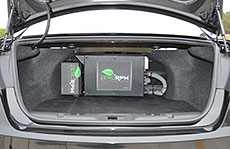
Power for climate control and other essentials can be supplied by an auxiliary battery pack unit that fits neatly in a vehicle’s trunk.
Argonne National Laboratory estimates that more than one million long-haul heavy-duty trucks idle during required rest stops. As the trucks idle, they consume more than one billion gallons of fuel per year. In addition, thousands of work trucks idle to support jobs daily, and millions of passenger cars idle waiting in traffic, drive-throughs, or drop-off/pickup situations. Accounting for all road vehicles, from passenger cars to heavy-duty trucks, Argonne estimates that more than 6 billion gallons of gasoline and diesel combined are lost to idling every year. Even when fuel prices are as low as $2 per gallon, that wasted fuel translates into more than $11 billion annually—much of which could be saved with idle reduction technologies.
Improving Air Quality
Idle reduction strategies can reduce air pollutants as well as noise pollution.
Increasing Energy Security
The transportation sector accounts for approximately 30% of total U.S. energy needs and 70% of U.S. petroleum consumption. Using idle reduction strategies to reduce petroleum consumption strengthens national energy security by increasing flexibility during natural disasters and fuel supply disruptions, as well as reducing transportation energy costs for businesses and consumers.
Complying with Laws and Ordinances
Many states have idle reduction laws and incentives. In addition, many counties and municipalities have enacted idling restrictions. View Clean Cities and Communities IdleBase to access a database covering idling laws, from the local level to the state level spanning all types of on-road vehicles. For information specific to heavy-duty trucks, see the American Transportation Research Institute's Idling Regulations Compendium.
In some areas, heavy-duty trucks and trains are required to limit noise at night. By adopting idle reduction strategies and technologies, vehicle operators can comply with noise standards.
 Maps & Data
 Case Studies
 Publications
 Tools
Tools