
Electric Vehicle Charging Stations
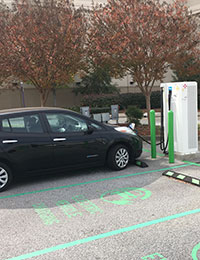
Tens of thousands of electric vehicle (EV) charging stations are available in the United States. These charging stations are being installed in key areas throughout the country for public charging and workplace charging as a supplement to residential charging. Most EV owners do the majority of their charging at home.
Station Locations
Find charging stations by location or along a route. Use the Advanced Filters to search for private and planned stations, as well as charging stations to match certain search criteria.
Charging Infrastructure Development
Consumers and fleets considering electric vehicles (EVs)—which include all-electric vehicles and plug-in hybrid electric vehicles (PHEVs)—need access to charging stations. For most drivers, this starts with charging at home or at fleet facilities. Charging stations at workplaces and public destinations may help bolster market acceptance by offering more flexible charging opportunities at commonly visited locations. Community leaders can find out more through EV readiness planning. The EVI-X Toolbox offers resources to estimate the charging infrastructure necessary to support typical daily travel in a given state or city, charging infrastructure needs to support long-distance travel (100 miles or more) along highway corridors in a given state or county, and to determine how EV charging will impact electricity demand.
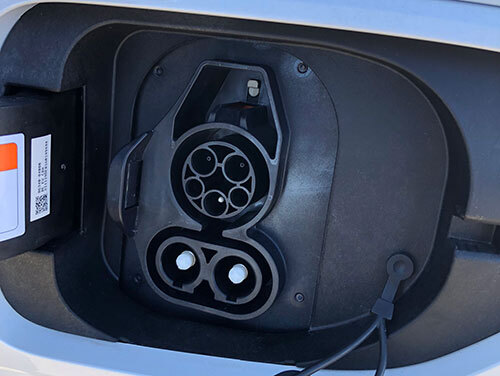
The Combined Charging System (CCS), also known as the SAE J1772 combo, charge port on a vehicle can be used to accept charge with Level 1, Level 2, or DC fast charging equipment.
Charging the growing number of EVs in use requires a robust network of stations for both consumers and fleets. The Alternative Fueling Station Locator allows users to search for public and private charging stations. Quarterly reports on EV charging station trends show the growth of public and private charging and assess the current state of charging infrastructure in the United States. Report new charging stations for inclusion in the Station Locator using the Submit New Station form. Suggest updates to existing charging stations by selecting “Report a change” on the station details page.
For a list of ENERGY STAR certified chargers, see the U.S. Environmental Protection Agency’s Product Finder list. A listing of charging infrastructure manufacturers with the ability to filter by product type/features is available on the Electric Drive Transportation Association’s GoElectricDrive website. For information on available charging infrastructure models:
- Plug In America's PlugStar tool allows you to filter Level 2 residential chargers by price, cord length, and other features.
- EPRI’s Vetted Product List focuses on commercial equipment and evaluates products against industry standards (e.g., safety listing by a Nationally Recognized Testing Laboratory, Open Charge Point Protocol capability) and government program requirements (e.g., Buy America, ENERGY STAR). Note this is not a comprehensive list of all models available, and charging equipment manufacturers pay a fee and apply to have their products vetted and listed. Where possible, EPRI verifies compliance to third-party certifications. If certifications are not provided, the fields on compliance are manufacturer-reported.
Charging Infrastructure Terminology
The charging infrastructure industry has aligned with a common standard called the Open Charge Point Interface (OCPI) protocol, which uses specific terminology to describe charging infrastructure: station location, EV charging port, and connector. The Alternative Fuels Data Center and the Station Locator use the following charging infrastructure definitions:
- Station Location: A station location represents a physical place with one or more EV charging ports. Examples include a parking garage or a parking lot. In some cases like a large mall parking lot, there may be multiple station locations even if they have the same address.
- EV Charging Port (also called a charger): An EV charging port provides power to charge only one vehicle at a time even though it may have multiple connectors. The unit that houses EV charging ports is sometimes called a charging post, which can have one or more EV charging ports. EV charging ports are also sometimes referred to as electric vehicle supply equipment (EVSE) ports.
- Connector: A connector is what is plugged into a vehicle to charge it. Multiple connectors and connector types (such as CHAdeMO and CCS) can be available on one EV charging port, but only one vehicle will charge at a time. Connectors are sometimes called plugs.
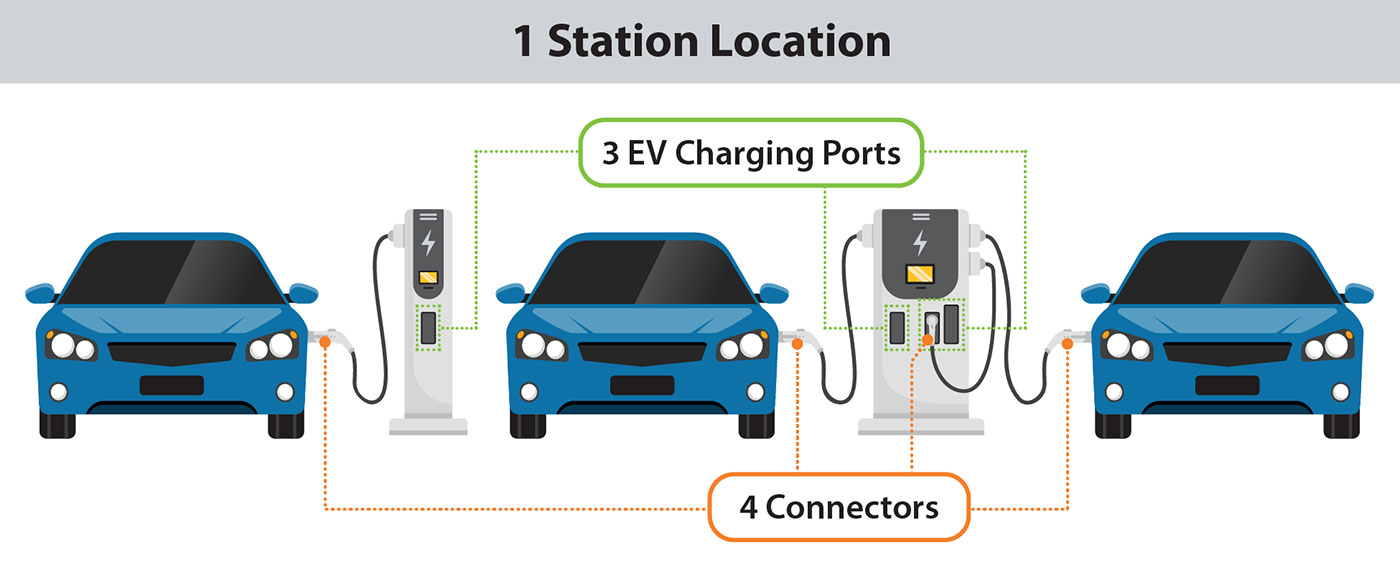
To better understand terminology for networked stations and how data is collected and displayed in the Alternative Fueling Station Locator, see Electric Vehicle Charging Networks.
Charging Equipment
Charging equipment for EVs is classified by the rate at which the batteries are charged. Charging times vary based on how depleted the battery is (i.e., state-of-charge), how much energy it holds (i.e., capacity), the type of battery, the vehicle's internal charger capacity, and the type of charging equipment (e.g., charging level, charger power output, and electrical service specifications). The charging time can range from less than 20 minutes using DC fast chargers to 20 hours or more using Level 1 chargers, depending on these and other factors. When choosing equipment for a specific application, many factors, such as networking, payment capabilities, and operation and maintenance, should be considered.
AC Level 1 Charging
Approximately 5 miles of range per 1 hour of charging*
Alternating Current (AC) Level 1 equipment (often referred to simply as Level 1) provides charging through a 120 volt (V) AC plug. Most EVs will come with a portable Level 1 cordset, so no additional charging equipment is required. On one end of the cord is a standard NEMA connector (for example, a NEMA 5-15, which is a common three-prong household plug), and on the other end is an SAE J1772 standard connector (often referred to simply as J1772, shown in the above image). The J1772 connector plugs into the car's J1772 charge port, and the NEMA connector plugs into a standard NEMA wall outlet.
Level 1 charging is typically used when there is only a 120 V outlet available, such as while charging at home, but it can easily provide charging for most drivers' needs. For example, 8 hours of charging at 120 V can replenish about 40 miles of electric range for a mid-size EV. As of 2023, less than 1% of public EV charging ports in the United States were Level 1.
* Assumes 1.9 kW charging power
AC Level 2 Charging
Approximately 25 miles of range per 1 hour of charging†

AC Level 2 equipment (often referred to simply as Level 2) offers charging through 240 V (typical in residential applications) or 208 V (typical in commercial applications) electrical service. Most homes have 240 V service available, and because Level 2 equipment can charge a typical EV battery overnight, EV owners commonly install it for home charging. Level 2 equipment is also commonly used for public and workplace charging and can operate at 40 to 80 amperes (Amp). Most residential Level 2 chargers operate at up to 30 Amps, delivering 7.2 kW of power. These units require a dedicated 40-Amp circuit to comply with the National Electric Code requirements in Article 625. As of 2023, nearly 80% of public EV charging ports in the United States were Level 2.
Level 2 charging equipment uses the same J1772 connector that Level 1 equipment uses. All commercially available EVs in the United States have the ability to charge using Level 1 and Level 2 charging equipment.
Vehicles with a J3400 connector (currently only Tesla vehicles) can use the connector for all charging levels, including Tesla's Level 2 Destination Chargers and chargers for home. All Tesla vehicles come with a J1772 adapter, which allows them to use non-Tesla Level 2 charging equipment.
† A Level 2 unit can range from 2.9 to 19.2 kW power output.
DC Fast Charging
Approximately 100 to 200+ miles of range per 30 minutes of charging‡

Direct-current (DC) fast charging equipment (typically a three-phase AC input) enables rapid charging along heavy traffic corridors at installed stations at power outputs up to 500 kW. This is also referred to as Level 3 charging. As of 2023, more than 20% of public EV charging ports in the United States were DC fast chargers. The availability of DC fast charging is expected to increase as a result of federal funding to build a national EV charging network, such as the National Electric Vehicle Infrastructure Formula Program, the national Alternative Fuel Corridors grant program, and the Charging and Fueling Infrastructure Grants. Additionally, DC fast charging is projected to increase due to fleets adopting medium- and heavy-duty EVs (e.g., commercial trucks and vans and transit), as well as the installation of fast charging hubs for transportation network companies (e.g., Uber and Lyft) and other applications.
There are three types of DC fast charging systems, depending on the type of charge port on the vehicle: SAE Combined Charging System (CCS), CHAdeMO, and J3400.
The CCS connector (also known as SAE J1772 combo) lets drivers use the same charge port with AC Level 1, Level 2, and DC fast charging equipment. The only difference is that the DC fast charging connector has two additional bottom pins. Most EV models on the market can charge using the CCS connector.
The CHAdeMO connector is another common DC fast connector type among Japanese automakers.
SAE International is standardizing the J3400 connector based on Tesla’s design for the NACS connector, which works for all charging levels, including Tesla's fast charging option, called a Supercharger. Although Tesla vehicles do not have a CCS or CHAdeMO charge port, they come with a limited CCS or CHAdeMO adapter that supports charging up to 19.2 kW. Tesla does sell full power adapters for both connector types. Several vehicle manufacturers have announced adopting the J3400 connector as early as 2025, which will allow non-Tesla EVs to charge at Tesla stations with the J3400 connector.
‡ A DC charging unit can provide up to 500 kW. Charging power varies by vehicle and battery state of charge.
Charging Infrastructure Procurement and Installation
Increasing available public and private charging equipment requires infrastructure procurement. Learn about how to successfully plan for, procure, and install charging infrastructure.
Charging Infrastructure Operation and Maintenance
Once charging infrastructure has been procured and installed, it must be properly operated and maintained. Learn about charging infrastructure operation and maintenance considerations.
Additional Charging Options
Another standard (SAE J3068) was developed in 2018 for higher rates of AC charging using three-phase power, which is common at commercial and industrial locations in the United States. Some components of the standard were adapted from the European three-phase charging standards and specified for North American AC grid voltages and requirements. In the United States, the common three-phase voltages are typically 208/120 V, 480/277 V. The standard targets power levels between 6 kW and 130 kW.
The Megawatt Charging System (MCS) is under development for DC charging up to 3.75 MW for short-dwell as well as lower power (<500 kW) long-dwell overnight charging for medium- and heavy-duty vehicle applications. A 2022 report looks at the requirements for charging stations that could support in-route charging for heavy-duty EVs. While 500 kW chargers are currently available from several charging manufacturers, the U.S. Department of Energy's Transportation Technologies Office is pursuing research that will bridge the technology gaps associated with implementing these networks in the United States. A 2017 report highlights technology gaps at the battery, vehicle, and infrastructure levels. In particular, many EVs on the roads today are not capable of charging at rates higher than 200 kW. However, vehicle technology is advancing, and most new EV models will be able to charge at higher rates, enabling the use of faster charging. You can find additional resources on EV charging and advanced charging system research efforts from the National Laboratory of the Rockies. For answers to frequently asked questions about the MCS and SAE J3271, see the fact sheet on Charging for Heavy-Duty Electric Trucks from Argonne National Laboratory.
Inductive Charging
Inductive charging equipment, which uses an electromagnetic field to transfer electricity to an EV without a cord, has been introduced commercially for installation as an aftermarket add-on. Some currently available wireless charging stations operate at power levels comparable to Level 2, though this technology is more common for transit or other fleet operations at higher power levels comparable to DC fast. The U.S. Department of Energy is conducting research to investigate the feasibility of high-powered wireless charging. More information on inductive charging research efforts is available from the National Laboratory of the Rockies.